
Pests and Diseases
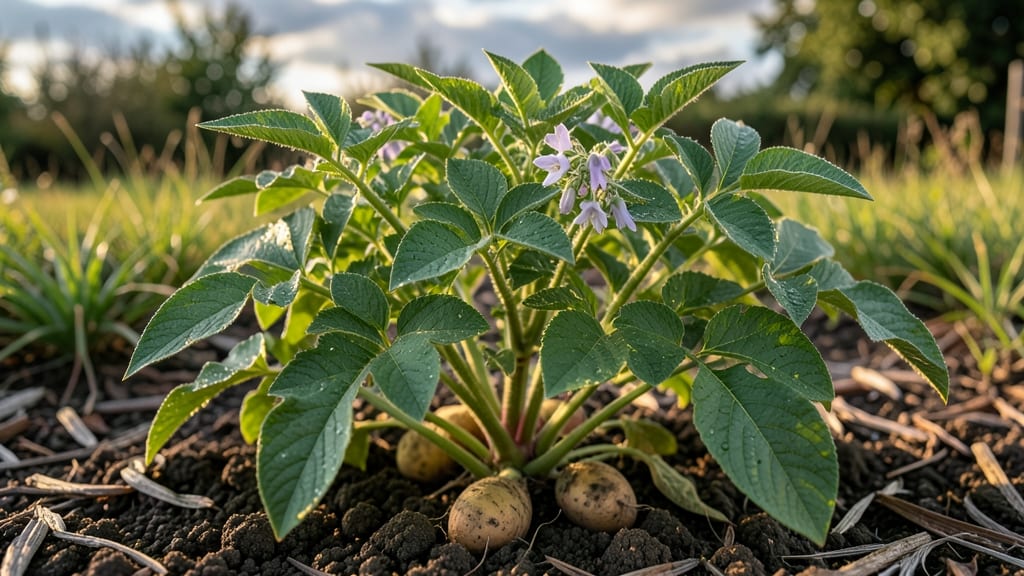
The five-point leaf disease appears as dark brown, five-lobed spots on tomato and potato leaves, caused by fungal pathogens Alternaria solani or Septoria lycopersici. Remove infected leaves immediately and use fungicides to stop the spread.
This fungal infection thrives in warm, humid conditions, making it especially problematic during rainy seasons or when plants are overcrowded. 🌱 The disease starts with small dark spots that expand into the classic five-pointed pattern, often surrounded by yellow halos.
If left untreated, it can weaken plants enough to reduce yields or even kill them. I always recommend checking the undersides of leaves first—those are where the early signs often appear.
Early intervention is key, so I suggest inspecting your plants regularly after rain or when humidity is high. Using resistant plant varieties and maintaining good airflow between plants can significantly reduce the risk of infection.
For existing infections, copper-based fungicides are my go-to for organic options, while chemical treatments like chlorothalonil offer broader protection.
💡 In This Article
- Causes and Symptoms of Five-Point Leaf Disease
- Preventive and Treatment Strategies for Five-Point Leaf
Causes and symptoms of five-point leaf disease
The five-point leaf disease gets its name from the characteristic five-lobed lesions that form on infected leaves, created by the fungal pathogens Alternaria solani and Septoria lycopersici. These fungi produce microscopic spores that spread through wind and water splashes, landing on leaves and germinating under ideal conditions.
The spores penetrate leaf tissue through natural openings like stomata or directly through the cuticle, especially when humidity exceeds 75% for prolonged periods.
Early symptoms appear as small, dark brown or grayish spots—often less than 1/8 inch in diameter—on the upper leaf surface. As the disease progresses, these spots develop into the signature five-pointed pattern with radiating lines, surrounded by yellow halos caused by the plant's response to fungal toxins.
The undersides of leaves frequently show more severe symptoms first, with dense fungal growth appearing as fuzzy gray or black patches. In advanced cases, infected leaves may drop prematurely, exposing stems to secondary infections.
The disease thrives when temperatures range between 60-85°F with high humidity, making it particularly aggressive during summer rains or in densely planted gardens with poor airflow.
Overhead irrigation also spreads spores, creating a perfect environment for infection. 🌧️ What most gardeners miss is how the fungus can survive in plant debris between seasons, ready to reinfect the next planting.
This persistence is why thorough cleanup after harvest is critical—removing all infected plant material reduces spore populations by up to 90%.
Advanced symptoms include blackened stems and fruit lesions that appear as concentric rings, often with white fungal growth in the center. These stem infections can girdle the plant, cutting off water and nutrient flow to upper leaves.
The disease progresses faster in stressed plants—those suffering from nutrient deficiencies, drought, or physical damage—making them three times more susceptible to infection than healthy plants.
Here's what to watch for in your garden:
- Early stage: Tiny dark spots (1/16 inch) on leaf edges, often with water-soaked appearance
- Intermediate stage: Five-pointed lesions with 1/4 inch diameter and yellow halos
- Advanced stage: Large brown patches covering entire leaves, blackened stems, and fruit lesions
Understanding these progression stages helps with early detection.
I always recommend examining the lowest leaves first—they often show symptoms 7-10 days before upper leaves, giving you crucial time to intervene before the disease spreads systemically. 🔍 The key is catching it before the five-point pattern fully develops, when treatment is most effective.