
Plants
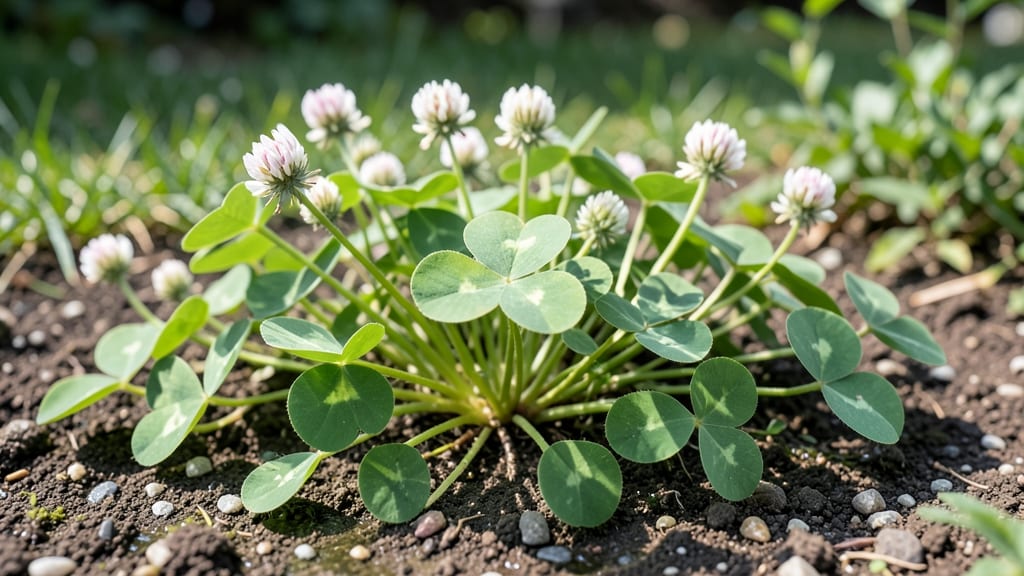
Four-leaf clovers look like standard three-leaf clovers but have one extra leaf—usually small, heart-shaped, or oval—attached to the central stem. Their leaves are bright green, serrated edges, and arranged symmetrically with four leaves instead of three.
These lucky plants typically grow on low, spreading stems with leaves clustered close together. 🌿 The extra leaf is often the smallest and may appear slightly different in shape or size compared to the other three.
While they resemble shamrocks, true four-leaf clovers have perfectly symmetrical leaves without deformities. Many people confuse them with mutated three-leaf clovers or other clover varieties, but the key difference is the consistent four-leaf pattern.
You'll most commonly find them in grassy areas during spring and summer when clovers are actively growing. The best way to spot them is by examining leaves closely—look for that fourth leaf nestled among the other three.
Using a magnifying glass can help distinguish them from lookalikes, especially in dense grass where they blend in easily.
💡 In This Article
- How to Identify a True Four-Leaf Clover vs. Common Lookalikes
- Best Ways to Spot Lucky Four-Leaf Clovers in Nature
How to identify a true four-leaf clover vs. common lookalikes
True four-leaf clovers (Trifolium repens) differ from imposters in their precise botanical structure. The fourth leaf typically emerges from the same central stem as the other three, creating a perfectly symmetrical "X" shape when viewed from above.
Unlike mutated three-leaf clovers, which often have irregularly shaped extra leaves, the fourth leaf in a genuine specimen measures 1-3 millimeters smaller than the primary leaves and maintains the same serrated edges. 🌱 The stem itself is usually 2-5 centimeters long with a reddish-brown hue near the base, distinguishing it from shamrocks (Oxalis acetosella), which have heart-shaped leaves on a different plant family entirely.
The symmetry of a four-leaf clover is its most defining feature. Each leaf should form a 120-degree angle from its neighbors, creating a balanced pattern. Shamrocks, by contrast, have three leaves arranged in a more triangular formation with less uniformity.
Even deformed clovers (caused by viral infections or environmental stress) will show signs of damage like discoloration or uneven growth. True four-leaf clovers maintain vibrant bright green coloration throughout their growth cycle, while imposters often develop yellow or brown spots as they age.
Lighting plays a crucial role in identification. When examining clovers in natural daylight, the fourth leaf often appears slightly translucent due to its thinner structure.
This translucency becomes more visible when held up to sunlight, a trick experienced clover hunters use to verify authenticity. 🌞 Another key detail is the leaf's texture: genuine four-leaf clovers have a slightly waxy surface that reflects light differently than the matte finish of lookalikes.
This subtle difference helps distinguish them from three-leaf varieties even when the extra leaf isn't immediately obvious.
Common imposters include:
- Shamrocks: Belong to the wood sorrel family with heart-shaped leaves and a distinct sour taste
- Deformed clovers: Often have extra leaves but show signs of disease or damage
- Clover hybrids: Some varieties produce four leaves through genetic mutation but lack the perfect symmetry
For those seeking to verify a find, the "finger test" works well: gently press the clover between your thumb and forefinger. A true four-leaf clover will have four distinct leaves that feel equally firm, while imposters often reveal structural weaknesses or asymmetrical pressure points.
This tactile method helps confirm authenticity without damaging the plant.