
Planting
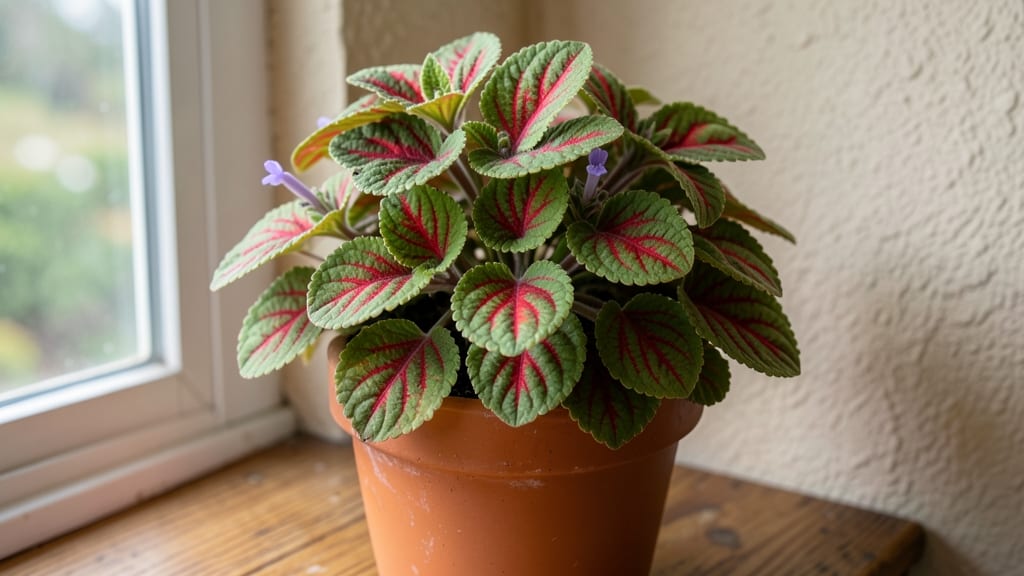
Plants with green leaves and red veins, such as Coleus or Swiss chard, showcase bold foliage where deep burgundy or crimson veins stand out against bright green leaf surfaces. Recognize them by their vivid contrast and grow them in bright indirect light with well-draining soil to keep their colors vibrant.
These plants aren't just visually stunning—their striking red veins are a result of anthocyanins, natural pigments that thrive in specific light conditions. 🌿 For instance, Coleus varieties like 'Black Dragon' or 'Wine and Roses' are prized for their deep, almost black-red veins, while Swiss chard brings a more subtle yet equally dramatic contrast.
The key to maintaining that bold look? Avoid direct sunlight, which can bleach the red tones, and use a mix of potting soil with perlite to prevent root rot from overwatering.
If you're growing these indoors, a south-facing window with sheer curtains works best—it mimics the bright but diffused light these plants love. Outdoors, partial shade during peak afternoon hours helps preserve the vibrant hues.
I’ve found that rotating plants every few weeks ensures even color distribution, preventing one side from fading faster than the other.
💡 In This Article
- Identifying Plants with Green Leaves and Red Veins
- Optimal Light, Water, and Soil for Vibrant Red-Veined Foliage
Identifying plants with green leaves and red veins
The vivid contrast between green leaves and red veins is primarily caused by anthocyanins—water-soluble pigments that thrive in specific light conditions. In plants like Coleus, these pigments accumulate in the leaf veins when exposed to bright but indirect light, creating that dramatic burgundy or crimson pattern.
For example, the 'Black Dragon' Coleus variety features almost black veins, while 'Wine and Roses' displays softer red tones—both develop their color intensity under 4,000-6,000 lux of light, similar to what you'd find near a south-facing window with sheer curtains.
Leaf shape and texture also help with identification. Swiss chard typically has broad, arrowhead-shaped leaves with prominent red veins that run parallel along the midrib, while Coleus leaves are often more rounded with intricate vein patterns resembling lace.
Begonias, another common variety, have glossy, waxy leaves where the red veins radiate outward like spiderwebs. 🌿 The key difference? Coleus leaves grow in a rosette pattern, while Swiss chard forms a more upright, stalk-like structure.
Touching the leaves can also reveal texture clues—Coleus leaves are usually soft and velvety, whereas Swiss chard leaves have a slightly crisp edge.
What most gardeners overlook is how growth habits vary by species. Coleus, for instance, thrives as a compact, bushy plant reaching 12-18 inches tall, making it perfect for containers or hanging baskets.
Swiss chard, on the other hand, can grow 2-3 feet tall and is often harvested for both its leaves and stems. Begonias tend to trail, which is why they're popular in hanging planters.
This growth variation directly impacts how you'd use them in your garden—Coleus for borders, Swiss chard for edible gardens, and Begonias for cascading displays.
Distinguishing these plants from lookalikes requires checking the undersides of leaves. True red-veined plants often have lighter green or even purple undersides, while imposters like certain ferns or ivies will show uniform green.
Another pro tip: Pinch off a small leaf and examine the stem—Coleus stems are square-shaped, while Swiss chard stems are round and hollow. 🌱 This anatomical detail can save you from misidentifying a plant and providing incorrect care.
Color intensity also serves as a natural identifier. Plants grown in cooler temperatures (below 65°F) tend to develop deeper red veins due to increased anthocyanin production, while warmer conditions may dilute the color. This is why many gardeners notice their red-veined plants looking more vibrant in spring or fall.
Pay attention to how the color changes with seasons—this can help you determine if you're dealing with a true red-veined variety or a plant that's simply reacting to temperature shifts.
For a quick field test, observe how the plant responds to light changes. Move it to a shadier spot for a week—if the red veins fade significantly, you're likely dealing with a light-sensitive variety like Coleus.
Swiss chard, however, maintains its red veins even in lower light conditions, though the overall leaf color may become less vibrant. This simple experiment can help you match the plant to its ideal growing conditions before you commit to full care routines.