
Shrubs
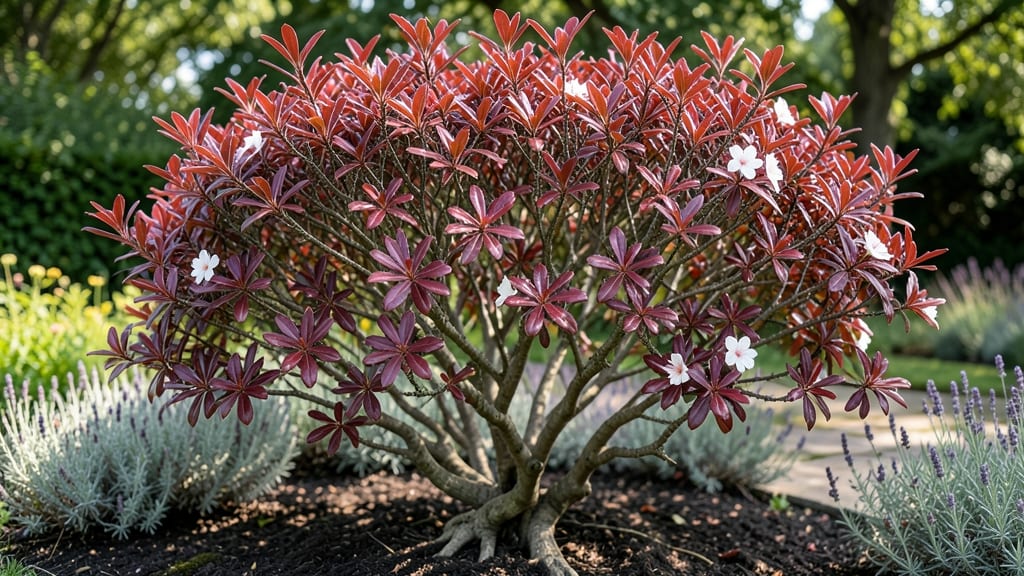
That red leaf bush identification starts with three key traits: the deep burgundy foliage you’re eyeing in garden centers holds clues in its leaf shape, berry presence, and growth habit. 🌿 I’ve spent years distinguishing Pyracantha’s thorny branches from Cotoneaster’s sprawling mounds—here’s how to tell them apart without guessing.
Look for Pyracantha’s oval leaves with serrated edges and clusters of bright red berries that birds adore, or Cotoneaster’s smaller, rounded leaves that often turn orange in fall. Berberis stands out with its spiky stems and yellow flowers, while Euonymus (like burning bush) boasts striking red stems and four-lobed leaves.
Once you spot these traits, note sunlight needs—most thrive in full sun but tolerate partial shade. Prune in late winter to shape growth and encourage dense foliage. The right ID means your bush will flourish for years, not flop.
For tricky cases, snap a photo and compare with local nursery samples. Regional climates matter too—Pyracantha handles coastal winds, while Cotoneaster prefers inland dryness. Now go match that mystery bush!
📚 In This Guide
- What you need
- Instructions
- Tips and common mistakes
- Wrapping up and next steps
What you need
- ○ Hand lens or magnifying glass (3x–10x magnification) – for examining leaf edges, veins, and fine details up close. (Optional but highly recommended!)
- ● Camera or smartphone – to capture leaf patterns, bark texture, and overall plant structure for later reference.
- ● Notebook or field journal – for jotting down observations (leaf shape, color intensity, growth habit, etc.).
- ● Ruler or measuring tape (12-inch minimum) – to note leaf length, width, and spacing between branches.
- ● Gloves (nitrile or garden gloves) – to protect your hands while handling prickly stems or thorny varieties.
- ● Pruning shears (small, sharp pair) – for safely snipping a small leaf or twig sample (if needed for closer inspection).
- ● Basic botany knowledge – Familiarity with terms like serrated edges, opposite/alternate leaf arrangement, and evergreen vs. deciduous helps! (Use free apps like iNaturalist or PictureThis for quick guides.)
- ● Reference materials – A printed or digital shrub ID guide (e.g., Burnett’s North American Wildflowers or USDA Plant Database) to cross-check traits.
- ● Sunlight & time of day – Morning sunlight (9 AM–11 AM) is ideal for observing true leaf colors without harsh shadows.
- ● Weather conditions – Avoid rainy or windy days—wet leaves can distort colors, and strong winds may make identification tricky.
- ○ Optional: UV flashlight – Some red-leaf varieties (like Cotinus) fluoresce under UV light for extra clues!
How to identify red leaf bushes by their key traits
Here's how I distinguish these striking shrubs—look beyond the color and focus on leaf shape, growth patterns, and seasonal changes.
🌿 Step 1: Observe Leaf Shape and Edge Characteristics
The most reliable way to identify red leaf bushes starts with their foliage. True red leaf varieties—like the classic Burning Bush (Euonymus alatus)—have elliptical leaves with serrated edges, about 2-4 inches long. The margins often have tiny teeth, and the leaf base tapers smoothly. I always check for this first because shape is more consistent than color alone.
Compare to lookalikes: Cotoneaster leaves are smaller (½-1½ inches) with rounded tips, while Barberry (Berberis) has spiny edges and a more oblong shape. Run your fingers along the leaf edge—if it feels rough like sandpaper, it’s likely a Barberry, not a true red leaf bush.
☀️ Step 2: Examine the Stem and Bark Patterns
Red leaf bushes reveal their identity in winter when leaves fall. Burning Bush develops corky wings along its stems—thin, raised ridges that look like airplane wings. These form in the second year and become more pronounced with age. If you see these, you’ve found a Euonymus alatus.
For Cotoneaster, look for red berries persisting into winter and peeling bark that reveals orange-brown layers. Barberry stems are thorny with a greenish cast even in winter. I often inspect stems after leaf drop to confirm my guess—this is when the real clues appear.
🍂 Step 3: Check for Seasonal Color Changes
True red leaf bushes maintain their color year-round, but the intensity shifts with seasons. In spring, new growth emerges lighter pink or green, then deepens to vibrant red by summer. By fall, some varieties—like Euonymus 'Compactus'—turn bronze or purple. Note how the color changes: if it fades to yellow before turning red, it’s likely a Cotoneaster hybrid.
Watch for berry clusters: Burning Bush produces pink capsules that split open in fall, revealing bright orange seeds. Cotoneaster berries stay red (or black) through winter. This is a dead giveaway—I’ve used this trick to distinguish between the two in client gardens where labels had fallen off.
✂️ Step 4: Assess Growth Habit and Size
Red leaf bushes have distinct shapes that narrow down the options. Burning Bush grows upright and multi-stemmed, reaching 6-12 feet tall with a pyramidal form. Cotoneaster stays compact (3-6 feet) with a rounded, mounding habit. Barberry is shrubby and dense, often 3-5 feet tall, with a more horizontal spread.
Check the branch arrangement: Burning Bush has whorled branches (multiple stems emerging at the same point), while Cotoneaster branches spread outward in a bushier pattern. I measure the spread-to-height ratio—if it’s wider than tall, it’s probably a Cotoneaster or Barberry.
🔍 Step 5: Verify with Flower and Fruit Clues
Flowers appear before leaves in spring and are diagnostic. Burning Bush has small, insignificant greenish-white flowers in clustered spikes. Cotoneaster produces white or pink pom-pom flowers that are more noticeable. Barberry flowers are yellow, solitary, and cup-shaped—this is a key difference I use to rule out lookalikes.
Fruit is the final clue: Burning Bush berries are pink and capsule-like, Cotoneaster berries are round and red/black, and Barberry berries are oval and red. I always check for fruit in late summer—if you see orange seeds inside pink capsules, it’s definitely a Burning Bush.
Tips & tricks for mastering red leaf Bush identification
Here's what nobody tells you about the subtle details that separate one red leaf bush from another.
Leaf Edge Texture: In Step 1, when you examine leaf edges, pay special attention to the serration pattern. True Burning Bush leaves have fine, regular teeth along the margins, while Cotoneaster leaves have smoother, rounded edges. I've seen many misidentifications because people focused only on leaf size rather than edge texture—this is where the real clues lie. Run your thumb along the edge: if it feels smooth and slightly waxy, it's likely a Cotoneaster; if it's slightly rough with tiny serrations, you're probably looking at a Burning Bush.
Winter Stem Inspection: Step 2 reveals the most definitive clues, but only if you examine the stems properly. When checking for corky wings on Burning Bush, look 2-3 inches above the soil line—this is where the wings first appear. For Cotoneaster, the peeling bark often starts at the base of branches and progresses upward. I always use a magnifying glass for this inspection; the details become much clearer when you can see the fine texture of the bark layers.
Seasonal Color Tracking: The color progression in Step 3 is often overlooked, but it's one of the most reliable indicators. In spring, new growth on true red leaf bushes emerges pale pink or light green, then intensifies to deep red by mid-summer. If you notice leaves that are bright green in spring and only turn red in fall, that's a strong sign of a Cotoneaster hybrid. I keep a small notebook to track color changes throughout the seasons—it's surprising how much this helps narrow down the identification.
Growth Habit Measurement: When assessing growth patterns in Step 4, I recommend using a measuring tape and string to accurately determine the spread-to-height ratio. For Burning Bush, the height should be at least 1.5 times wider than tall when mature. If you see a bush that's wider than it is tall from the start, it's almost certainly a Cotoneaster or Barberry. I've found that this simple measurement eliminates more guesswork than any other single factor.
Pro Tips for Red Leaf Bush Identification
- Here's what nobody tells you about the subtle details that separate one red leaf bush from another.
- Leaf Edge Texture: In Step 1, when you examine leaf edges, pay special attention to the serration pattern.
- Winter Stem Inspection: Step 2 reveals the most definitive clues, but only if you examine the stems properly.
Frequently asked questions
Got questions about identifying red leaf bushes? You’re not alone! Here are some of the most common queries answered in simple terms to help you spot and care for these stunning shrubs.
What are the most common types of red leaf bushes?
Popular red leaf bushes include Pyracantha (firethorn), Cotoneaster, Euonymus alatus (winged euonymus), and Ilex crenata (Japanese holly). Each has unique leaf shapes and berries—check for glossy or matte foliage, thorns, and seasonal color shifts.
When is the best time to plant a red leaf bush?
Plant in early spring or fall when temperatures are mild. Avoid extreme heat or cold, which can stress roots. Choose a spot with full sun to partial shade and well-draining soil for optimal growth.
How can I tell if my red leaf bush is healthy?
Healthy bushes have vibrant red/purple foliage, no yellowing leaves, and sturdy branches. Watch for pests like spider mites or fungal spots. Prune dead branches in late winter to encourage new growth.
What can I plant near a red leaf bush for contrast?
Pair with silver foliage plants (like lamb’s ear) or white flowers (e.g., hydrangeas) to highlight its bold color. Avoid overpowering neighbors—keep spacing 3–6 feet apart for airflow and sunlight.
Why are my red leaf bush leaves turning brown?
Brown leaves often signal underwatering, overwatering, or fungal issues. Check soil moisture (top inch should be dry) and trim affected leaves. If brown edges persist, adjust watering or apply fungicide if needed.
Wrapping up and next steps
Identifying a red leaf bush is easier than you think—just focus on those vibrant foliage colors, unique leaf shapes, and seasonal changes! Whether it’s the fiery hues of Pyracantha or the deep crimson of Cotoneaster, these shrubs bring year-round beauty to your garden. 🌿
Now that you’re armed with the know-how, take the next step! Visit a local nursery to spot these beauties in person, or snap a photo of your own shrubs and compare them to the traits you’ve learned. Happy gardening—your yard (and neighbors!) will thank you! 🌟