
Leaf Blower
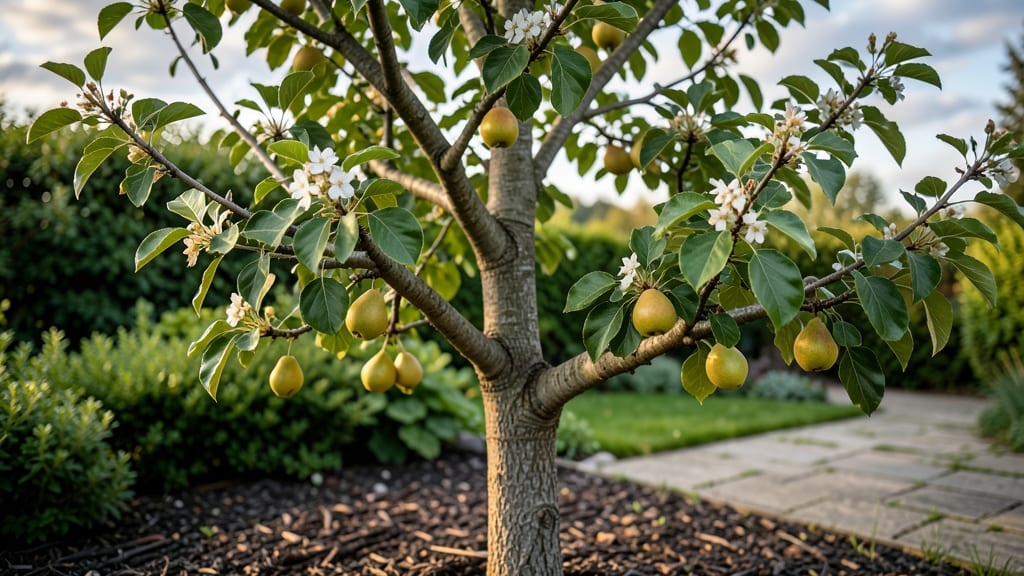
Identifying a Bartlett pear tree by its leaf means spotting glossy, deep green, oval-shaped foliage with serrated edges and a slightly waxy feel. These leaves typically measure 2 to 4 inches long, featuring a prominent midrib and fine branching veins.
Bartlett pear leaves stand out because their oval shape and pointed tips create a distinctive silhouette that's easier to spot than other pear varieties. 🌿 The serrated edges help distinguish them from smoother-leaved trees like Anjou pears, while the waxy coating gives them a slightly reflective quality when sunlight hits just right.
I've found that examining the underside of the leaf—where the veins create a subtle network—often confirms the identification when the top looks similar to other species.
These leaves also change subtly through the seasons, starting bright green in spring and developing a deeper hue as summer progresses. In fall, they may turn yellowish before dropping, but they rarely develop the fiery reds or purples seen in some ornamental pear varieties.
Paying attention to these seasonal shifts helps rule out lookalikes and confirms you're dealing with a true Bartlett.
💡 In This Article
- Leaf Shape and Texture: Bartlett Pear Tree Distinctive Features
- Seasonal Changes in Bartlett Pear Tree Leaves: What to Watch For
Leaf shape and texture: Bartlett pear tree distinctive features
The Bartlett pear tree's leaves are like nature's calling card, designed with precision to thrive in temperate climates. Their oval shape measures about 2-4 inches long and 1-2 inches wide, tapering to a graceful pointed tip that sets them apart from rounder varieties like Anjou.
This shape creates a 1:2 length-to-width ratio, making them instantly recognizable when compared side-by-side with other pear species.
The serrated edges are another key identifier—each leaf has 10-15 tiny teeth along its perimeter, resembling a fine saw blade. These serrations aren't as pronounced as those on hawthorn leaves but are more consistent than the occasional teeth found on Bosc pears.
The leaves' waxy surface gives them a slightly slick feel when rubbed between fingers, thanks to a natural cuticular layer that reduces water loss—a botanical adaptation that helps the tree conserve moisture during dry periods.
What makes Bartlett leaves truly distinctive is their midrib prominence. The central vein is thick and raised, creating a subtle ridge that's visible even when the leaf is flat.
From this midrib, secondary veins branch out at 45-degree angles, forming a delicate network that's more pronounced on the underside. This vein pattern creates a subtle "fingerprint" that helps differentiate Bartlett from other pears when leaves look similar from above.
In direct sunlight, Bartlett leaves develop a slightly bluish-green hue due to a waxy bloom that reflects certain light wavelengths.
This iridescent quality becomes more noticeable in morning or late afternoon light when the sun angle enhances the leaf's natural sheen. 🌿 Unlike Anjou pears, whose leaves often appear duller, Bartlett leaves have this subtle shimmer that's almost metallic when viewed at the right angle.
When comparing Bartlett leaves to other common pear varieties, the differences become clear. Anjou leaves are broader with smoother edges, while Bosc leaves tend to be narrower with more pronounced serrations.
The Bartlett's balanced proportions and uniform texture make it stand out in any orchard setting, which is why experienced growers often identify trees by their foliage alone before seeing the fruit.
One fascinating detail is how the leaf's texture changes with age. Young leaves emerging in spring are softer and slightly furry along the veins, but they quickly develop their characteristic waxy coating as they mature.
This texture transformation is a survival mechanism—young leaves are more vulnerable to pests, so the initial fuzziness provides some protection before the waxy layer takes over.